Klose Coaching
Your first AI project can easily make your business slower. As a former software engineer, I now see some teams slowed down by AI. It writes code in minutes, but the same number of people still have to review it all. If your business sends quotes, AI can draft them faster, but they still queue for approval. The customer waits as long as before.
A big plan is tempting, but it’s hard to know what AI will look like even three months out. So I suggest starting with an MVP, a minimum viable product. That is the smallest piece of AI you can put to real work within weeks. You learn from it and build on it without locking in what comes next.
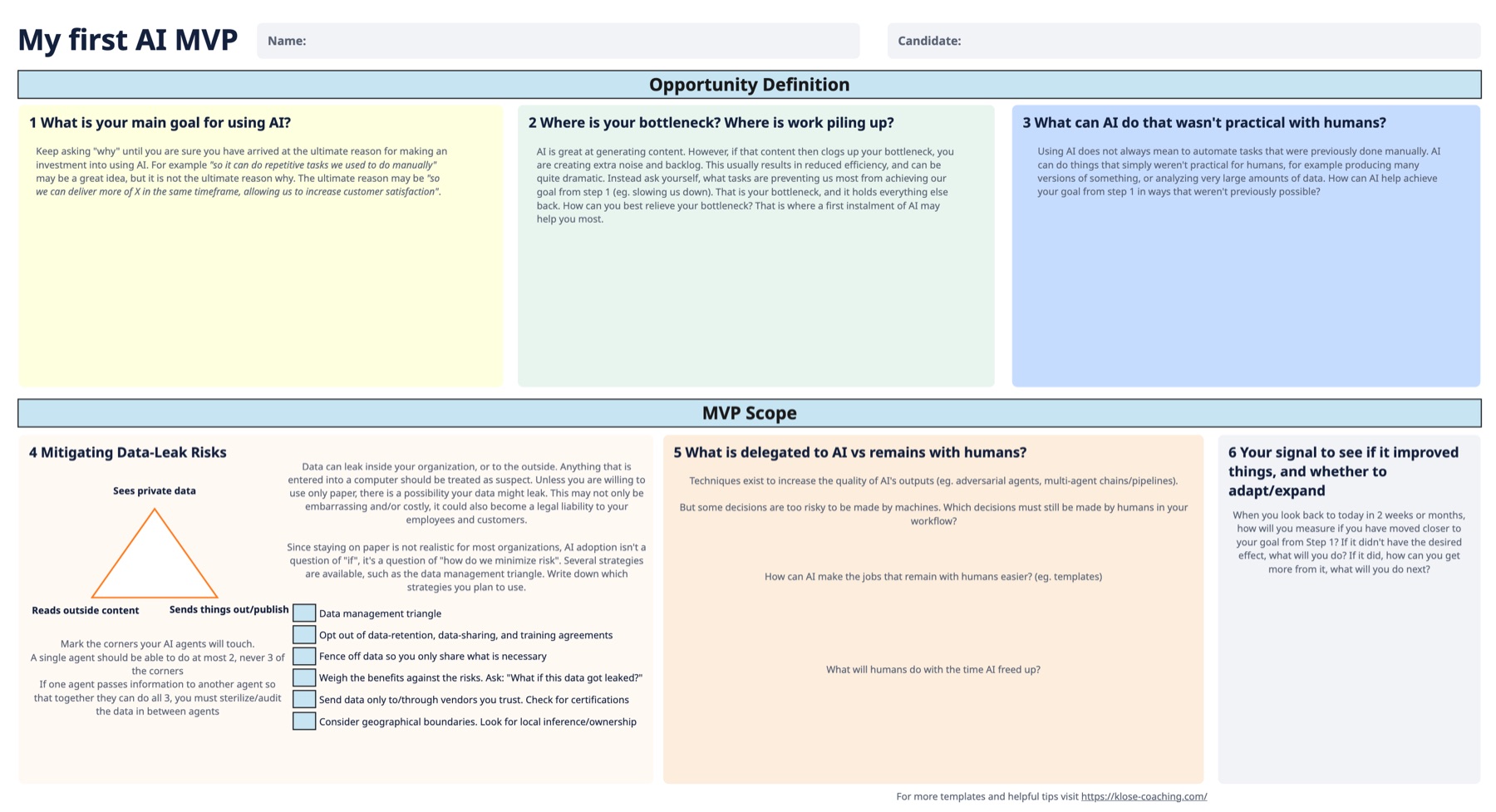
The canvas is a one-page sheet of six questions. You fill it in for one candidate, meaning one AI idea you are weighing. The first three find where AI would help most, and the last three keep the first try small, safe and measurable.
1. What is your main goal for using AI?
Keep asking “why” about the result you want, and write down the reason you end on. If your first answer is “AI takes over repetitive tasks”, ask why: perhaps to deliver more in the same time and keep customers happier.
2. Where is your bottleneck? Where is work piling up?
Your bottleneck is the step everything after it waits on. Write down the task that most holds you back from the goal in step 1, and how AI could relieve it. Speeding up a step before the bottleneck only adds to its pile.
3. What can AI do that wasn’t practical with humans?
AI can do work that was never practical by hand, such as producing many versions of something or analyzing large amounts of data. Write down one use that serves your goal, for example reading hundreds of past customer reviews for patterns, a job that rarely gets done.
4. Mitigating data-leak risks
Anything you enter into a computer can leak, and a leak can cost money and leave you legally liable to employees and customers.
An AI agent is AI that carries out tasks on its own. One way to keep an agent’s risk low is the data management triangle. Its three corners are what an agent might do: see private data, read outside content, and send things out or publish. Mark the corners each agent will touch; the canvas allows two at most. If two agents together cover all three, check and clean the data before it passes between them.
Tick the other strategies on the canvas that fit, for example:
- opt out of settings that let your vendor keep, pass on or train on your data
- share only the data the task needs
5. What is delegated to AI, and what stays with humans?
Write down which decisions stay with a person: those about people, and any that would be costly or hard to undo. Write how AI could make the person’s part easier, for example by setting out each decision with options and a recommendation. Add what people will do with the time AI frees up.
6. Your signal: did it improve things, and should you adapt or expand?
Before you start, write down what you will count to track progress toward your goal. The count keeps you honest, because when you want a project to work, you tend to notice the signs that it does. Ask: did the work just move onto someone else, such as a colleague who fixes what AI drafted? Pick a date, a few weeks or months out, to decide: scale the project, fix it or stop it.
The canvas ends on a question: what will you do next? A small first project lets you answer it from what you measured.
Download the canvas and fill it in for one candidate.